Allentown PA · April 24, 2026 · Blog

Selling a House Fast in Allentown PA — What Lehigh Valley Sellers Need to Know in 2026

Redfin reports Allentown homes receiving 6 offers on average and selling in 12 days. Movoto shows active listings priced at $299,900 with 48 days of market time. Those numbers aren't contradicting each other — they're describing two different segments of the same city. Which one your property sits in determines whether a quick cash sale or a traditional listing is the right move.

What the Data Actually Shows

According to Redfin (March 2026), the median sale price in Allentown is $247,000 — essentially flat year-over-year, down 0.18% — with homes receiving an average of 6 competing offers and going under contract in about 12 days. That's a genuinely competitive market by any measure. Zillow puts the average home value at $267,465, up 7.0% over the past year, with properties going pending in roughly 7 days.

Movoto's market snapshot tells a different story at the top of the funnel: active listings priced at a median of $299,900 with 48 days on market. The gap between $299,900 list and $247,000 sale price isn't a pricing error — it's the market doing what markets do. Some sellers anchor to Zillow's value estimates (which reflect the full metro housing stock) and price accordingly. Then they sit.

The lesson for Allentown sellers: the homes pulling 6 offers are move-in-ready properties in the right neighborhoods, priced correctly against actual comparables. The homes sitting at 48 days are usually the overpriced, the outdated, or the ones with deferred maintenance that conventional buyers can see through immediately.

South Side vs. West End — Two Different Markets Inside One Zip Code

Allentown is not a monolithic market. The city covers 17.8 square miles with neighborhoods that have fundamentally different housing stocks, buyer pools, and price trajectories.

The West End — roughly the area around West Park and Lehigh Parkway, west of 15th Street — has Allentown's established larger homes: Tudor-style colonials, brick Foursquares, and Victorian-era houses on wider lots. These pull the value metrics up. Updated homes here sell quickly to buyers who work in Allentown's financial and healthcare sectors, or remote workers priced out of the Philadelphia suburbs to the east.

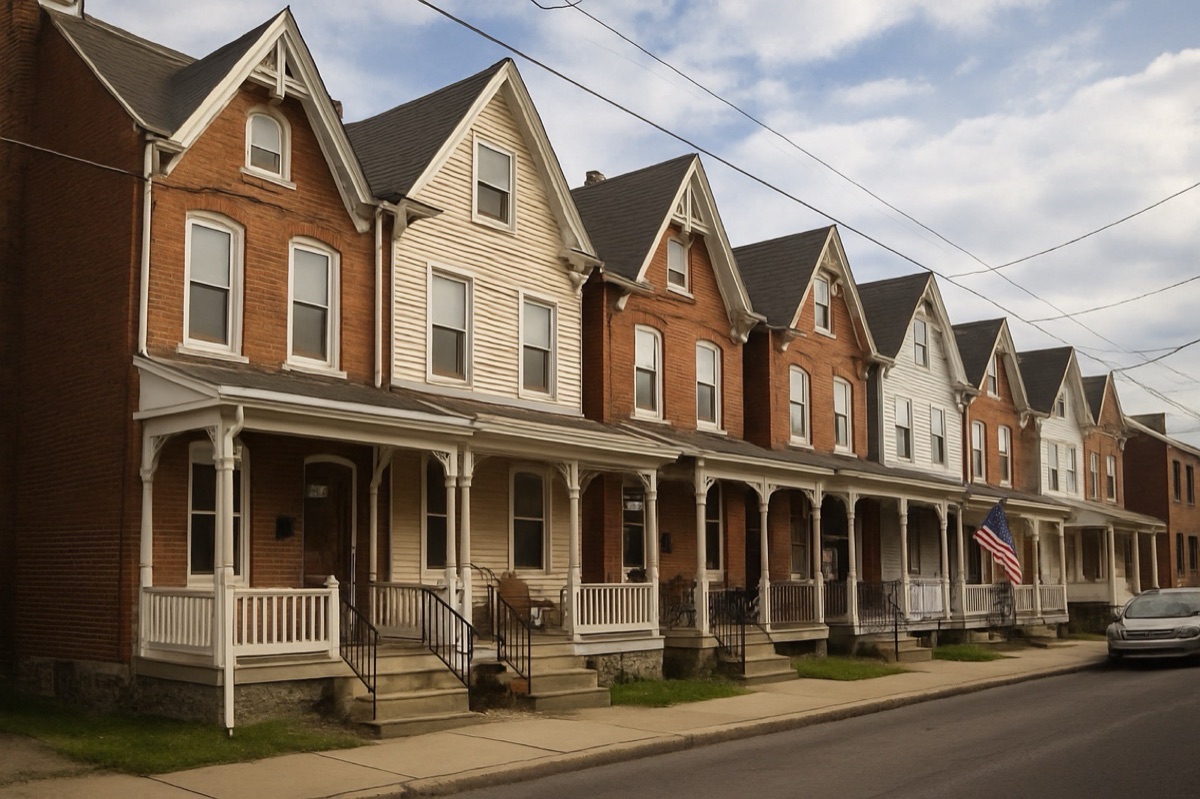
The South Side, east of 7th Street and south of Linden, is a different situation. Dense row homes, many built between 1900 and 1940, with the maintenance profiles you'd expect from a century-old housing stock. Roof lines that have been patched repeatedly. Electrical panels that date to the 1970s. Basements with water intrusion from the Lehigh Valley's clay-heavy soil. These homes sell — there's genuine demand from first-time buyers priced out of suburbia — but they often need work that either the seller can't fund or the buyer can't get financed around.

The East Side runs between 7th and 15th, with a mix of pre-war housing that's increasingly attracting investor interest and renovation-oriented buyers. Hamilton Park and Jordan Heights are where the upgrade activity has concentrated in recent years.

Why Allentown Is Growing — And Why That Matters for Sellers

The Lehigh Valley is experiencing real population growth, not just regional reshuffling. According to the Lehigh Valley Economic Development Corporation, the Valley ranked as the number-one mid-size market in the United States for economic development in 2025. Census data shows the Allentown-Bethlehem-Easton metropolitan area population reached 696,845 in 2023, making it one of the fastest-growing markets in the Northeast.

The drivers are specific: logistics and warehousing (the Valley sits on I-78 between New York and Philadelphia, a distribution sweet spot), healthcare expansion anchored by Lehigh Valley Health Network and St. Luke's University Health Network, and sustained population migration from the Philadelphia suburbs by buyers who can no longer afford Montgomery County but still need access to the city.

For sellers, this growth creates real demand — but it's demand for specific things. A logistics worker relocating from Essex County needs a move-in-ready house near I-78. A healthcare professional transferring from Doylestown needs a turnkey colonial in the West End. They are not looking for a South Side row home with a 200-amp electrical upgrade still on the to-do list. That's the market gap cash buyers fill.

What It Actually Costs to Sell in Allentown

Pennsylvania's realty transfer tax is 1% at the state level under 72 Pa. Stat. § 8102-C, plus a 1% local component split between the City of Allentown and the Allentown School District — making the combined rate 2% of the sale price. By convention in Pennsylvania, buyer and seller split this evenly, meaning you'll owe approximately 1% of the sale price at closing.

On a $247,000 sale, that's roughly $2,470 in transfer taxes on the seller's side. Add agent commission — Lehigh County commissions typically run 5-6% — and you're looking at $12,350 to $14,820 in commission alone. Closing costs typically add another 1-2%. The gross picture of $247,000 becomes net proceeds of roughly $215,000 to $225,000 before any repairs or holding costs are factored in.

That math looks different if your home needs $20,000-$30,000 in updates to compete. A property that would sell at $247,000 as-is but could fetch $285,000 after a kitchen renovation and electrical panel replacement often doesn't pencil out on the renovation path — once carrying costs during the work, the renovation costs themselves, and post-renovation commission are subtracted, the net difference frequently narrows to a few thousand dollars or disappears entirely.

When you sell to a cash buyer, you skip commission, skip transfer tax splits (buyers typically cover), skip repair costs, and skip the 45-to-60-day post-pending financing period. The offer is lower than full market value — typically in the 70-80% range depending on condition — but the net comparison deserves honest math, not a reflexive "always list" assumption.

Pennsylvania Foreclosure — What Lehigh County Homeowners Need to Know

Pennsylvania is a judicial foreclosure state, meaning every residential foreclosure goes through the Lehigh County Court of Common Pleas before a sheriff sale can be scheduled. Federal mortgage servicing rules require a 120-day period from the first missed payment before a servicer can file. Pennsylvania Act 91 of 1983 adds a 30-day notice requirement directing borrowers on primary residences toward the Pennsylvania Housing Finance Agency (PHFA) before the lender can file suit. The actual foreclosure action — complaint, service, answer period, judgment — adds more time on top of that.

In practice, the timeline from first missed payment to Lehigh County sheriff sale is typically 12-18 months, sometimes longer depending on court scheduling. That's a window. But the window closes, and it closes hard: once a judgment is entered and the sale is advertised, your options narrow quickly.

If you've received a foreclosure complaint from Lehigh County Court of Common Pleas — that formal legal notice arriving by certified mail — you still have time to sell. A cash buyer can close in 7-14 days. The mortgage payoff comes out of proceeds at closing; whatever equity remains is yours. The key is not treating that complaint as something to set aside. It's the start of a clock.

Inherited Homes — Lehigh County Probate

If you've inherited an Allentown property, the sale runs through Lehigh County Orphans' Court. The Register of Wills office handles probate filings at the Lehigh County Government Center, 17 South 7th Street, Allentown, PA 18101. Once Letters Testamentary or Letters of Administration are issued — typically 4-8 weeks from a complete filing, absent complications — the appointed personal representative has statutory authority under 20 Pa. C.S. § 3101 to sell the real estate.

Pennsylvania's inheritance tax applies to probate transfers: 4.5% to direct descendants, 12% to siblings, 15% to other heirs. This tax is calculated on the fair market value of the inherited asset and is owed to the Commonwealth at settlement, not to the buyer. It doesn't block the sale, but it reduces what you net, which makes minimizing carrying costs during the probate period — property taxes, insurance, utilities on a vacant home — a real financial consideration.

A significant share of inherited Allentown homes fall into the older stock category: pre-war row homes or early postwar ranches that have been in a family for 40-50 years. They're paid off (or nearly so), which means the estate gets most of the proceeds. But they also haven't had capital improvements in decades, which means the as-is value and the retail-ready value have a wide spread — and renovating an estate property while managing probate from out of state is rarely the efficient path.

The Lender-Condition Problem in Older Allentown Housing

Allentown's older housing stock runs into a recurring problem with conventional and FHA financing: lenders have property condition requirements that a century-old row home often can't meet without upfront repair investment. FHA appraisers flag deferred roof maintenance, exposed electrical, evidence of water intrusion, and peeling paint in pre-1978 homes (lead paint disclosure requirements). Conventional lenders have similar triggers.

The result: a buyer who needs financing can't get the loan approved until the repairs are done. The seller either pays for repairs they may not be able to afford, or the deal collapses. In Allentown's competitive market, another buyer comes along — but usually not for a property with known financing obstacles. Cash buyers don't have lenders setting conditions. The offer is for the property as it stands; there's no conditional funding that can crater at the appraisal stage.

The Bottom Line for Allentown Sellers in 2026

Allentown's market is genuinely strong for the right properties. Updated homes in the West End, Hamilton Park, and Jordan Heights are selling fast with multiple offers — if you have one of those and the time to go through the listing process, a traditional sale makes sense.

But a substantial portion of Allentown's housing inventory is older stock that carries maintenance histories, financing obstacles, and the kind of deferred work that turns a fast market slow in a hurry. For those properties — and for sellers in foreclosure, probate, divorce, or relocation situations regardless of condition — the math on a cash sale is frequently closer than it looks, and the speed and certainty are unambiguous advantages.

USA Home Buyers covers all of Lehigh County and the Allentown metro. Written cash offer within 24 hours of seeing the property. Typical close in 7-14 days. We handle all closing costs, including the Lehigh County transfer taxes. Call 888-274-5006 or fill out the form below.

Get Your Allentown PA Cash Offer

Takes 2 minutes. No obligation.

By submitting, you agree to our Privacy Policy and Terms of Service. You consent to receive calls and texts from USA Home Buyers. We never share your information.

📞 Call NowGet Cash Offer →